



The sacred origin and symbolic colors of the Buddhist Flag
Table of contents [Hide]
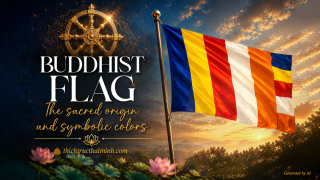
The Buddhist Flag is a familiar symbol and source of pride for Buddhist followers. Significantly, the five-color flag was designed based on the Buddhas radiant, pure aura during the fourth week after his enlightenment, a sacred event in the history of Buddhism.
The article below will help you explore the origin and historical development of the Buddhist flag, as well as its meaning, to better understand its sacred value.
The origin of the five-color Buddhist Flag
The Buddhist Flag was proposed by a former U.S. Army Colonel Henry Steel Olcott. He was not a Buddhist and came from a Protestant family. Olcott joined the Theosophical Society, a group studying spirituality, where he studied Buddhism. Later, he developed a strong enthusiasm for and a deep appreciation of Buddhism.
In 1880, he traveled to Sri Lanka and submitted a proposal for a Buddhist flag to the Colombo Buddhist Committee. He suggested a design featuring six colors, inspired by the Buddhas six-colored aura of the Buddha when he attained enlightenment under the Bodhi Tree.
After 49 days of meditation under the Bodhi tree (in present-day Bihar state, India), Prince Siddhartha attained enlightenment, titled Shakyamuni Buddha. He then remained near the Bodhi tree for seven weeks, savoring the joy of meditation, contemplating, and preparing to propagate the Dharma to all sentient beings.
In the fourth week, the Buddha used his supernatural powers to create a gem stupa in the Northwest—symbolizing the stupa of the Dharma. He resided in this stupa, observing, contemplating, and understanding the arising and ceasing of a ksana in the mind (the shortest possible unit of time).
During those seven days, he illuminated the mental streams, flows of mind, the unfolding and functioning of all sentient beings and all realms, and established the Dharma to guide and liberate sentient beings. At that moment, his body and mind became perfectly bright and pure, radiating a brilliant halo with many colors: blue, yellow, red, white, and orange, and a bright sixth color formed by blending the five above.
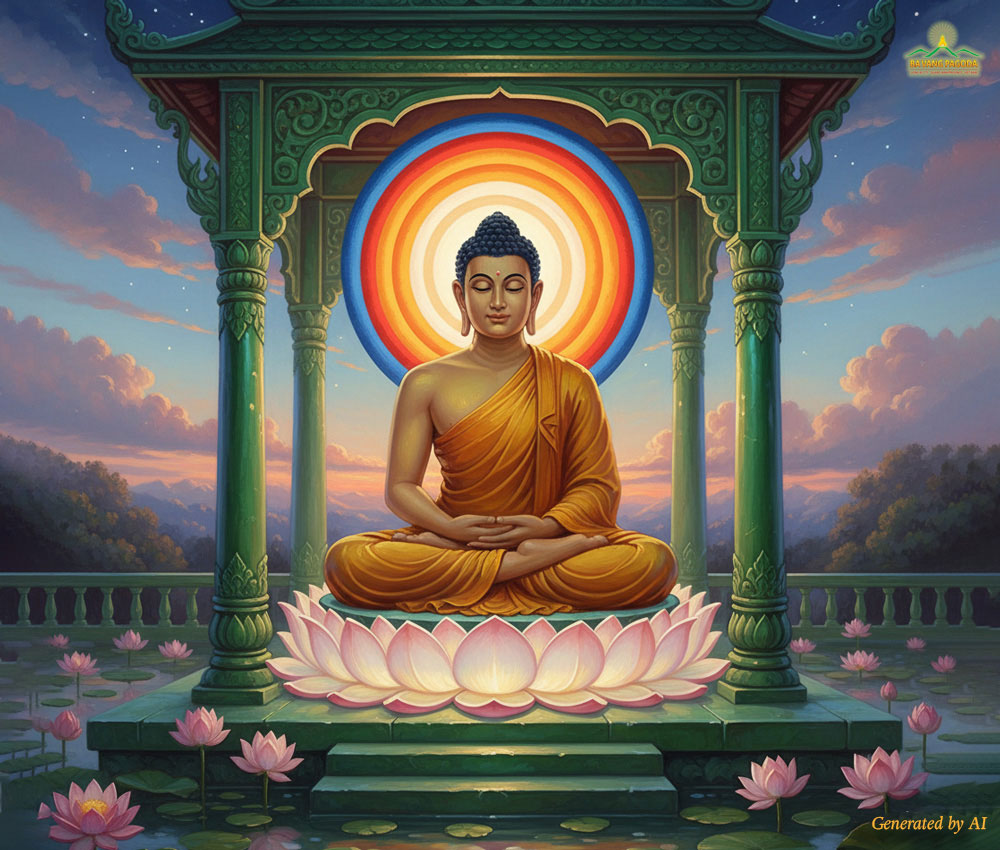
The Buddhas body and mind became absolutely bright and pure, radiating a brilliant aura (illustrative image)
Later, the flag proposed by Henry Steel Olcott was officially approved by the Colombo Buddhist Committee on April 28th, 1885, on the occasion of Vesak. It was formally adopted as the international Buddhist flag in 1950 at the inaugural meeting of the World Fellowship of Buddhists in Sri Lanka, attended by 26 countries, and has since become the sacred symbol of Buddhism. However, the adopted design features five colors, not six as originally proposed (as the sixth stripe is the blend of the other five).

The Buddhist flag was adopted with five colors
The meaning of the Buddhist Flag
The meaning of the five colors of the Buddhist Flag
The initial idea of the Buddhist Flag by Henry Steel Olcott was inspired by the aura of the Buddha. Later, various countries gave different meanings to the flag. Some countries interpret that the five colors of the flag symbolize five meanings:
- Blue represents meditation.
- Yellow represents the right thought.
- Red represents the spiritual energy and strength
- White represents faith.
- Orange represents wisdom.
- The sixth color, a combination of these five colors, represents peace and non-discrimination based on skin color or race.
Besides, in some other countries, it is believed that these five colors symbolize the power of practicing the Dharma - that is, the five faculties and the five powers:
- White represents faith
- Red represents effort
- Yellow represents mindfulness
- Blue represents concentration
- Orange represents wisdom
A symbol of the six harmonies and unity
Within the Buddhist flag, we can find the colors of our national flag because they are the fundamental colors. For example, Vietnam's national flag has yellow and red, and these two colors are also present in the Buddhist Flag. The final stripe of the flag where all colors converge, represents unity and the six harmonies. This is truly a unique meaning of the five-colored flag.
The Buddhist flag was brought to Vietnam on February 24, 1951, by Bhikkhu To Lien. As a representative of the World Buddhist Sangha Council in Vietnam, he attended the Colombo Conference and brought it to his homeland. Nowadays, the Buddhist flag has become a noble symbol, often flown alongside Vietnams national flag. This image signifies that Buddhism always accompanies and develops with the nation.
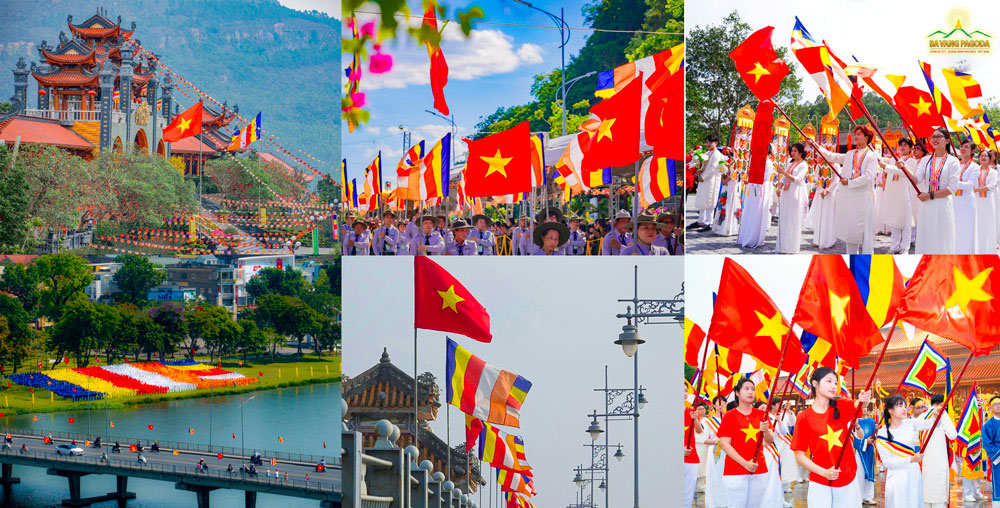
The Buddhist flag has become a noble symbol, often displayed alongside the Vietnams national flag
The above article is based on a Dharma teaching by Thay Thich Truc Thai Minh on the origin and meaning of the Buddhist flag. The flag is not only a symbol associated with the sacred aura of the Buddha but also signifies the message of unity, harmony, and compassion in Buddhism. Every time the flag flies, it embodies a source of pride for Buddhist followers, standing as a vivid testament to the enduring presence of the Buddha Dharma over thousands of years in history.